Do You Have Time to Play?

Ignore the play drive at your peril
The kids just went back to school after a four-day weekend. Monday my husband had a work holiday but I didn’t. I went into “get all the things done” mode, shuttling tons of overdue items from my to-do list to Monday. I figured my husband and kids would do stuff together, and I’d get stuff done.
Except this wasn’t actually a communicated expectation (is that part important?). So my husband and kids’ expectation for the day was that we’d do something together as a family, minus mom for a writing meeting I had in the morning and a couple hours of paid work in the afternoon.
At lunch as we tried to work it out, everyone wanted something different. I wanted to get stuff done. My husband wanted to do something as a family. My oldest wanted to go on some sort of excursion. My youngest wanted to stay home and play. But he wanted an adult to play with him.
I felt a pull toward my younger son’s desire to stay home and play. Even in a family where we try not to overschedule our kids, down time to play can too often end up on the chopping block. The kids have limited time to play during the school week, and weekends fill up fast, too. Over the four-day weekend, I had them cleaning their room (it needed it SO BADLY), doing a Costco run with me, going out of town for a concert—not luxuriating in play. My youngest was expressing a real need for things to slow down.
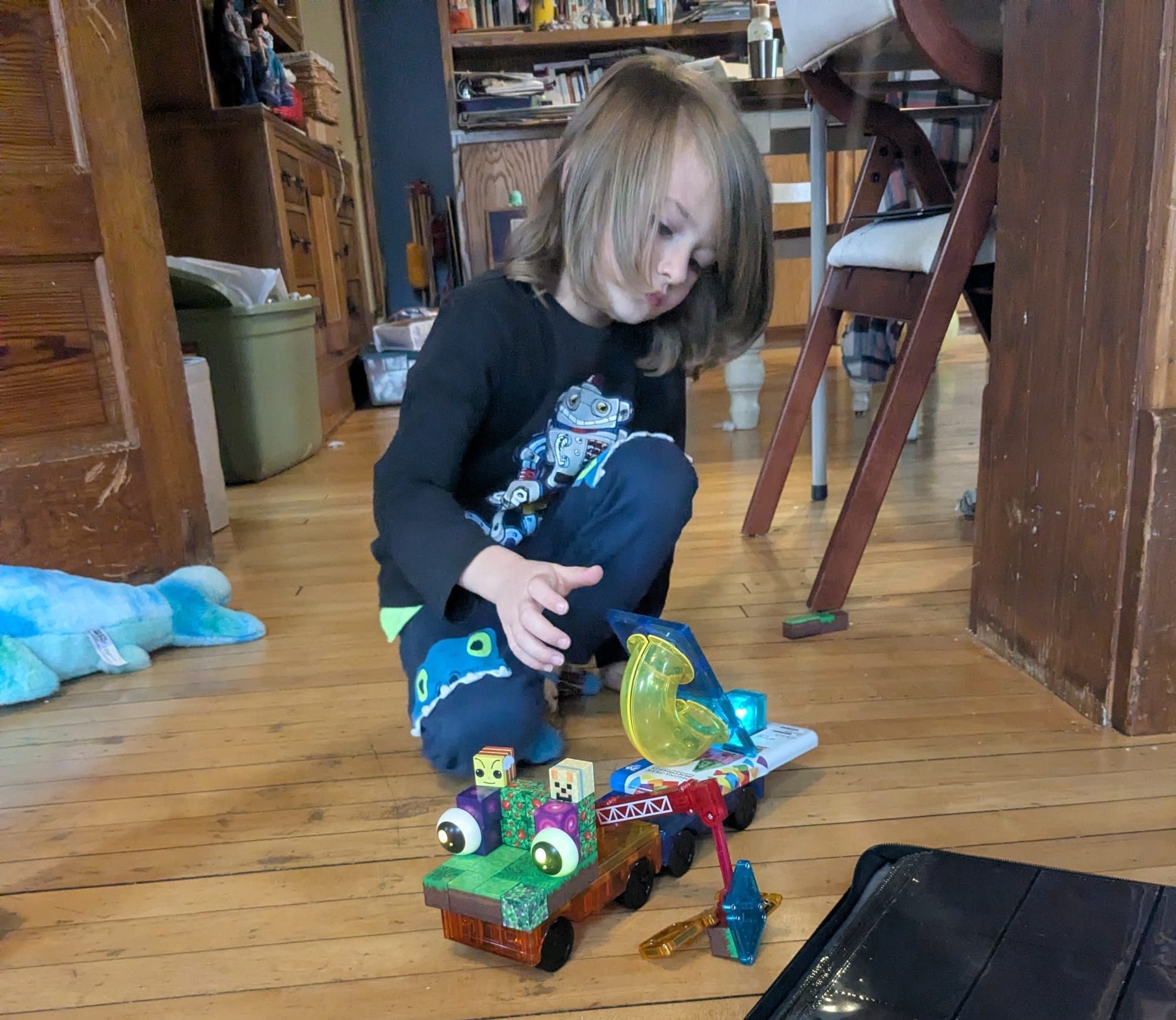
We finally agreed to an hour or two of at-home play, then a couple hours of video games with Dad while I worked. The living room was too messy for the sort of large-scale building my youngest wanted to do. So we spent almost an hour clearing clutter. When it was finally time to pull out the Magna-Tiles, my husband asked if I’d play with them for a bit while he took care of a few quick projects outside. I was resentful, only having one hour before my paid work shift and SO MANY THINGS TO DO.
He said, “Playing with them for 15 minutes isn’t going to destroy your whole schedule.”
I could have retorted that I can get a hell of a lot done in 15 minutes (school lunch packed for the next day, or a package mailed, or breakfast prep.) But I let it go and I sat down on the floor.
I can’t remember the last time I sat down on the floor to play with them.
My oldest son divided the most-coveted Magna-Tile pieces (wheel bases) among the three of us, making the executive decision that we were building campers. As I began fitting mine together, I thought about my camper year fantasy and how it’s all about presence and togetherness and a slower pace of life. My body began to relax as I rummaged through the bin and selected the appropriately sized blocks and tiles.
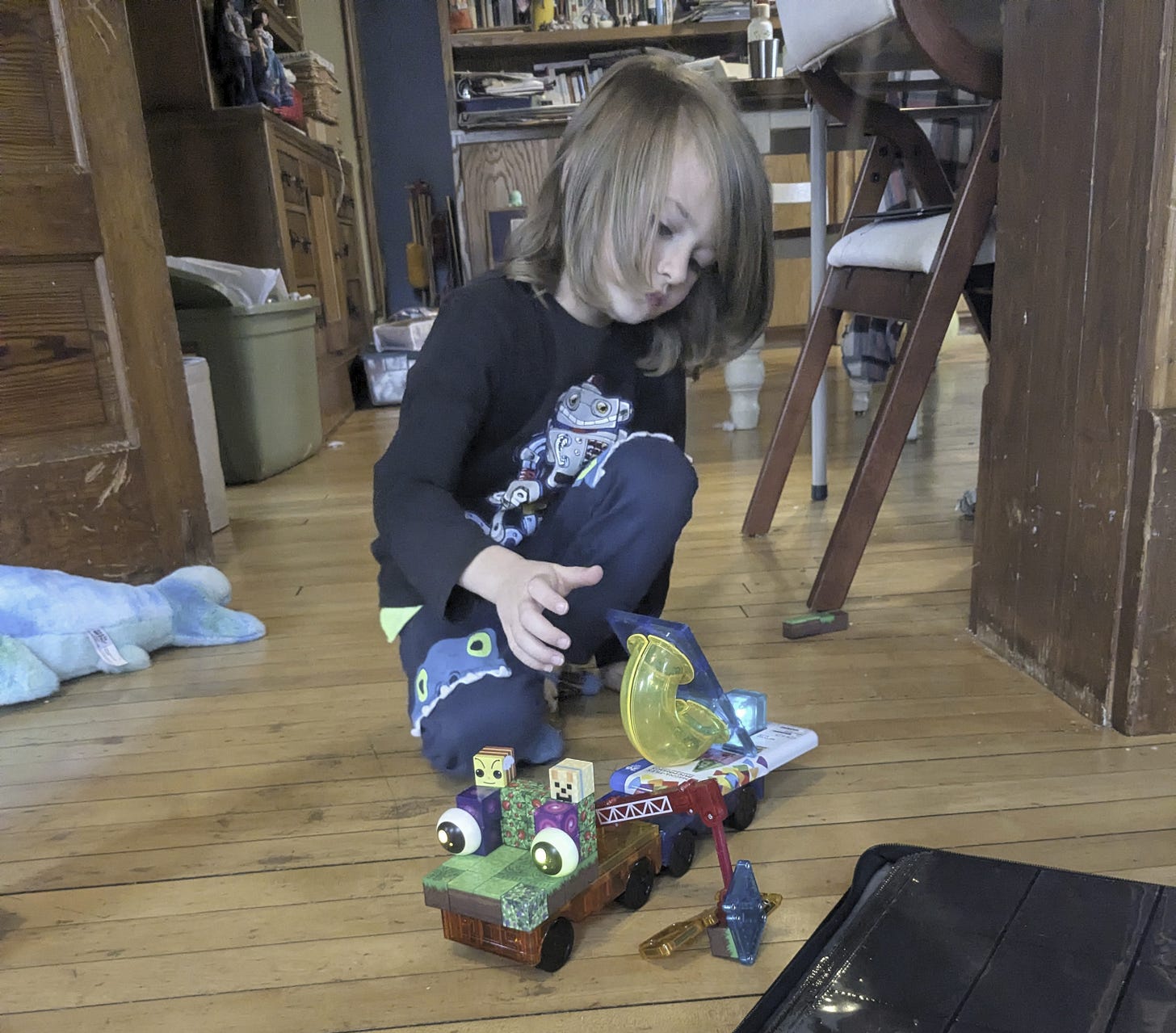
I hadn’t realized I needed this.
My camper was completed in half an hour, and I slipped away to pack my son’s lunch for the next day and pack an evening meal for the three of them who would be heading out to piano lessons around dinner time.
My relationship with play has been fraught since I was an adolescent and aware that I didn’t want to give it up. I was deeply invested in the stories I created with my dolls, calmed by the tactile sensation of brushing hair and doing up tiny buttons. I became so lost in my imaginary world that I missed a lot of what was happening in the real one. So when I rediscovered my most beloved characters a little over a year ago and decided to write about them again, I was scared. Scared of things getting out of balance. Scared of reduced presence in my real life where I am deeply necessary to my family’s smooth functioning and my children’s developing senses of themselves. Trying to get clarity on my own complicated relationship with play, I read Play: How it Shapes the Brain, Opens the Imagination, and Invigorates the Soul by Stuart Brown.
When I started writing about the characters I created in my adolescence, I thought I was drawing an important boundary by having a clear goal in mind—unlike the free-form, open-ended character play of my younger years, I was shaping these characters toward an end goal now, at least two interconnected novels. In my journal I wrote something along the lines of, “I don’t want to just PLAY. I want to be building something. I want to know what I’m working toward.”
Despite that, I let myself get pulled into play, into open-ended exploration.
And I created more than I’ve created in two decades. Prose, song lyrics, timelines, backstories. First I started scribbling in a notebook. This is basically journaling, I thought, so it’s OK that it doesn’t have a point. Then those scribbles started turning into fleshed-out scenes. Then those scenes started turning into stories that I hadn’t seen the shape of until I’d spit out all the individual puzzle pieces. I assembled See You Around, the short story I entered in this year’s Interactive Fiction Contest, “by accident” as I explored in this way. And that’s when I realized:
The distinction between play and creativity focused on a goal is absolute bunk.
You can’t really know which is which until you get in there and do it. Play and see what you find.
And creating in this way makes me feel more myself than I’ve ever felt before. My real life story and my inner, imaginary world integrated for the first time.
One of the most stunning revelations in Play is that the one thing all mass shooters have in common is that in childhood, their play was severely restricted.
If we deny ourselves play—or if authority figures in childhood deny us play—it can literally break us.
During last Friday’s “family fun night,” we watched Toy Story 5. In it, the toys face an existential crisis as screens come to dominate more and more of children’s “playtime.” Although I couldn’t help noting the irony of using a screen to tell families to beware of screens, the movie echoed many of my own concerns about an age of disappearing playtime. My older son has already instructed his little brother “not to talk to him about anything except screentime” when they’re at school, because this is the only acceptable way to spend free time in the world of Fourth Grade. My son’s classmates’ unbridled access to screens has led to us having to explain a lot of age-inappropriate content, from Skibidi Toilet to “Sigma” males to actual pornography. We limit our kids’ screentime (and monitor what they’re actually engaging with when they do use it) precisely because we fear the many benefits of play being lost to them. But it does raise a question echoed by the central conflict in the movie: Are kids who are being raised counter-culturally, even with the absolute best intentions, destined to be lonely?
My older son has found a fairly solid friend group, yet even from them he must hide his attachment to play, and one of them seems ready to disassociate from play altogether. My younger son is still searching for the friends he connects with.
Play tells a story about NASA management struggling because the younger engineers can’t problem-solve as well as the outgoing engineers, despite the fact that they’ve all got strong resumes, stellar backgrounds, high test scores. So what was missing? Play. The ability to play unlocks creative problem-solving, and it’s also crucial to bonding and being able to work together.
I’ve noticed the relationship between my sons breaks down when they’ve gone too long without playing together. They fight more. I don’t know why I thought my own relationship with my kids would be any different. Now that they’re older and more independent, too often I relegate myself to taskmaster and let them take care of the play stuff amongst themselves. I hope they will play well together so I can get stuff done or get lost in my own creativity alone.
Sitting on the floor with Magna-tiles yesterday, I realized how misguided that was. I rediscovered how important play was to my creativity, but I forgot how important it was to my bond with my kids. It’s so important that I feel the urge to put it on my To-Do List which seems to rule my life with an iron fist.
But the moment I do that, it ceases to be play.
So I’m trying to go forward with more openness toward play with my children, to stop being so annoyed by the toy clutter everywhere and instead treasure the fact that the toys are still important to them. And I’m trying to remember that the moments we all live for are the moments that don’t make the To-Do List.